After the Last Tab: A Five-Minute Evening Wind-Down for Screen-Tired Bodies
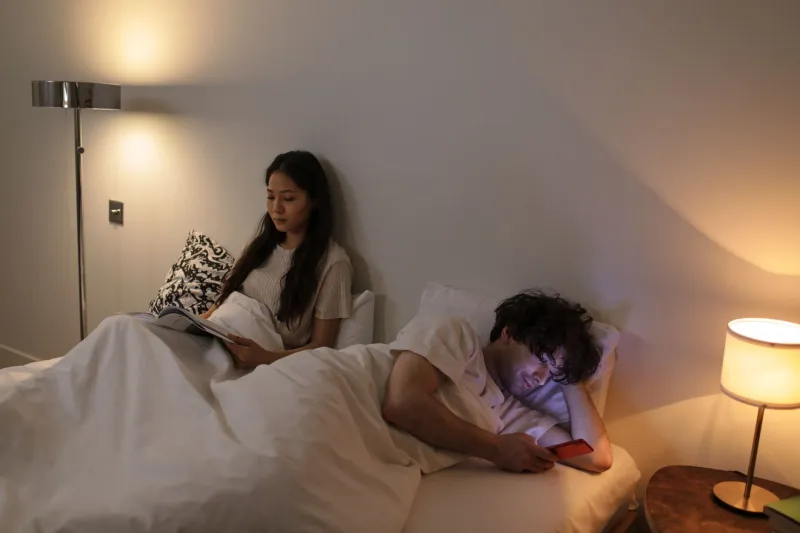
At 10:47pm, the last tab is still open. You have read the same sentence three times, the phone is warm in your hand, and your body has somehow forgotten that the day is over. The kettle has done its last hurrah. The telly is murmuring from the other room. And somewhere between the group chat and the weather forecast, you are meant to switch off.
This is not a lecture about blue light. It is an invitation to a softer landing.
The last hour is not a performance
We often treat the hour before bed like a final task on the list: wind down properly, drink the right tea, have the perfect routine, sleep like a calm person in a linen advert. That is a lot of pressure for a Tuesday evening. The solar plexus — that soft area at the base of your ribs, where your breath starts to move — is a useful place to return to because it asks for nothing impressive. You do not need to clear your mind. You just need to notice that you have a body, and that it is allowed to slow down.
A five-minute practice for whatever you are wearing
Do this in jeans, pyjamas, a hoodie, or the jumper you have worn all day. No mat required. No incense. If you are already in bed, stay there.
Minute one: put the phone down, not away from your life. Place it face down on the other side of the room, or on the bedside table with the screen off. Notice the small protest in your hand. Take one ordinary breath in through your nose. Let the exhale be a sigh — not a dramatic one, just a soundless deflation, as if you are setting down a heavy bag.
Minute two: find your solar plexus with your hands. Sit on the edge of the bed or cross-legged on the duvet. Rest one hand on your upper belly, just below where your ribs meet. The other hand can rest on your chest. Breathe in gently. Feel the lower hand move first, or at least try. There is no prize for getting it right. If your shoulders lift instead, soften them and try again on the next breath.
Minute three: a seated cat-cow, small and quiet. Hands on your knees. Inhale as you lengthen your spine and lift your chest a little. Exhale as you round your back and tuck your chin. Move slowly, maybe three or four rounds. This is not a workout. It is a way of telling your nervous system that the day is winding down, not ramping up.
Minute four: a gentle twist each side. Sit tall. Place your left hand on your right knee and your right hand behind you on the bed. Inhale. Exhale and turn towards the right, keeping it easy. Stay for two breaths. Come back to centre and change sides. If twisting feels uncomfortable, skip it. A slow shoulder roll is a perfectly good substitute.
Minute five: legs up, or simply lie down. If you have space, lie on your back and rest your calves on the bed or a chair, or put your legs up the wall. If that is too much faff, lie flat with a pillow under your knees. Hands back on your solar plexus. Take five slow breaths, letting the exhale be slightly longer than the inhale. Then stop counting. That is the whole practice.
If you feel restless rather than sleepy
Restlessness is not failure. It is information. Some evenings, the body is not ready to lie still, and forcing it can feel like trying to quiet a room by shouting.
Try this instead: stand up and shake out your hands for twenty seconds, as if you are flicking water off them. Then push your palms against a wall for five slow breaths, like you are gently holding the wall up. Or walk to the kitchen for a glass of water and come back by a slightly longer route. You are not delaying sleep. You are helping your body discharge the last of the day.
If your mind is the restless part, write one sentence on a Post-it or the back of an envelope: 'Tomorrow I need to...' or 'I am still thinking about...' Then leave it by the bed. You are not journaling your soul. You are parking a thought so it does not have to keep circling.
The point is not perfect sleep
You might still lie awake for a while. You might scroll again. You might do the practice and feel nothing except slightly more aware of your left foot. That is okay. The aim is not to become a person who falls asleep in four minutes flat. The aim is to give yourself a small, repeatable signal: the day is done, or nearly done, and you are allowed to stop performing it.
The solar plexus is a good anchor for this because it is right in the middle of things — not the head, where the lists live, and not the feet, which are already tired. It is the place where breath meets belly. A hand there says: I am here. The day can wait.
So tonight, after the last tab, try one sigh. Then another. Let the phone be a phone, not a portal. Let the bed be a bed. Five minutes is enough. And if it is not, the kettle will still be there in the morning.