The Last Mug Standing: A Three-Minute Kitchen-Sink Practice for Grounding
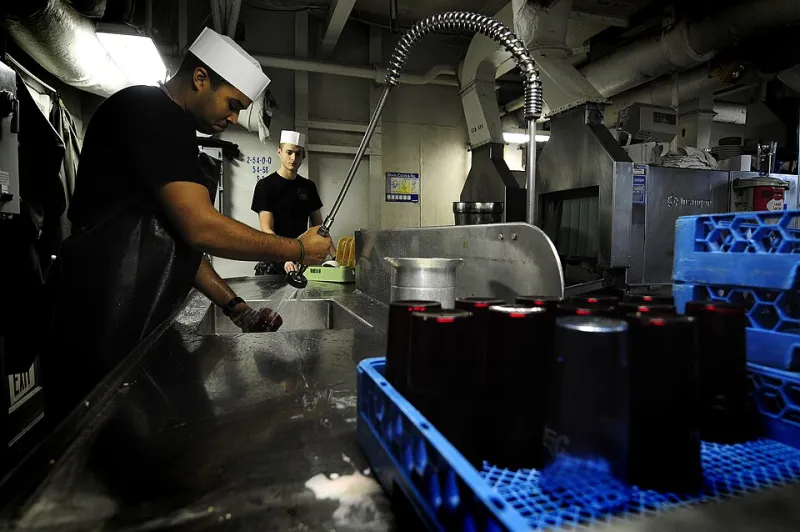
Photo: U.S. Navy photo by Mass Communication Specialist 3rd Class Christopher K. Hwang, Public domain, via Wikimedia Commons
A practice that fits between the plates
It is 7.40pm. The dinner plates are stacked, the last mug is standing by the sink, and the day is still humming somewhere behind your eyes. You have not rolled out a mat. There is no incense, no candle, no spare half-hour. There is just you, the tap, and a small pile of crockery.
At Manipura Yoga, we often return to the solar plexus as a place of quiet steadiness rather than a self-improvement project. The kitchen sink is one of the most honest places to meet that steadiness. You are already there. The water is already warm. Nothing extra needs to be arranged.
This is a three-minute practice, but please read that loosely. If you manage one conscious breath while rinsing a bowl, that counts. If you decide to sit on a kitchen chair halfway through, that counts too.
Why the sink works
The solar plexus area — the soft space below the ribs and above the navel — is not a muscle you have to tense into shape. In yoga, manipura is sometimes translated as the city of jewels, which sounds grand until you remember that most jewels are found in ordinary ground. The kitchen sink is ordinary ground. It is warm water, cold tiles, a tea towel that needs changing, the low hum of the boiler.
Standing at the sink also asks something simple of you: feet down, weight settled, hands busy. That is a grounding posture in disguise. You do not need to make it sacred. You just need to notice it.
The three-minute sequence
1. Take your stand, or your seat
Stand with your feet roughly hip-width apart. Let your knees stay soft rather than locked. If your kitchen floor is cold, that is fine — socks, slippers, bare feet, whatever you have. Rest your hands on the edge of the basin for a moment before you start.
If standing is uncomfortable, sit on a sturdy kitchen chair with a bowl of warm water on a towel in front of you. The practice works just as well seated. You are not trying to hold a pose perfectly. You are giving your body a clear, kind place to be.
2. Let your jaw be softer than the job
Before you pick up the first plate, unclench your teeth. Let your tongue rest away from the roof of your mouth. Roll your shoulders back and down once, then let them stay there. The dishes do not need your shoulders up by your ears.
This is the quiet heart of the practice: the solar plexus softens when the jaw and shoulders stop bracing. You do not have to force a feeling of calm. You just stop adding tension to the ordinary moment.
3. Borrow the tap’s rhythm
Turn on the tap, or fill the bowl if that is how you wash up. Listen to the water for a moment. Let that sound be your metronome.
Now breathe in through your nose for a gentle count of three. Breathe out for a count of four or five. Keep the breath quiet and unforced. If the breath feels tight or you feel light-headed, shorten the count or return to your natural breath. There is no prize for a longer exhale.
As you rinse a mug, let one full breath happen. As you soap a plate, let another. You are not matching the tap beat exactly; you are letting the sound remind you to return. If you lose count, begin again. That returning is the practice.
4. Wash one thing with full attention
Choose one object — the last mug, a saucepan lid, a spoon. Feel the warmth of the water, the slip of the soap, the weight of the thing in your hand. Notice the colour of the bubbles. Notice the small squeak of a clean surface.
This is not a mindfulness performance. You are not trying to feel blissful about washing up. You are simply letting one ordinary action be complete. The solar plexus often settles when the mind has one clear, gentle task.
5. End with a small pause
When you turn off the tap, pause before you walk away. Rest one hand on your belly, just below the ribs. Take one slow breath in and let it out. Notice what has changed, even slightly: a softer jaw, a lower shoulder, a little more space between your thoughts.
Nothing needs to be fixed. You are not graduating from this practice. You are just leaving the sink a little more present than you arrived.
If standing at the sink isn’t possible
You can do this at a table with a washing-up bowl, or seated beside the sink if your kitchen allows it. Keep the same order: settle your seat, soften your jaw, listen to the water, breathe with the rhythm of the tap, wash one thing with attention, then pause. Adapt the posture freely. A practice that fits your body is always better than a perfect one that doesn’t.
What this practice is not
It is not another routine to add to your evening. It is not a way to be a better person by having a cleaner kitchen. And it is not a test of whether you can stay present for three whole minutes.
The point is not a spotless sink. The point is a softer jaw, a breath that has room in it, and a moment of steadiness in the middle of a normal Tuesday. If the dishes sit in the rack a little longer because you paused, so be it.
A small invitation
Tonight, when you reach for the last mug, let it be a cue rather than a chore. Stand or sit. Let your shoulders drop. Listen to the tap. Breathe out a little longer than you breathe in. Wash one thing with your full attention.
You do not need a mat, incense, or a spare hour. The kitchen sink is already here. The practice is already waiting in the ordinary water.