A Quiet No: Noticing Your Yes, No and Not-Yet Before You Answer

Photo: Oceanic7777, CC BY 4.0, via Wikimedia Commons
Someone asks you something. Perhaps it's a Friday meeting that genuinely could have been an email, or a third weekend in a row at your mum's, or being the person who organises the collection for the leaving present. Either way, there's a small window — usually about two seconds — between the question and your answer.
Most of us spend that window entirely in our heads. We run a quick calculation: what will they think, what does the calendar look like, what kind of person says no to this. And then the mouth opens and out comes the yes.
The solar plexus is a much better place to spend those two seconds. It sits just below the ribs, where the ribcage softens into the belly — the area yoga traditions call manipura, the city of jewels. You don't need to believe in chakras to find it useful. You just need to notice what happens there when somebody asks you for something.
The pause lives in your middle
For a lot of people, the body answers before the mind catches up. A request lands and there's a tightening under the ribs, or a small drop, or a flutter that feels oddly like dread dressed up as enthusiasm.
That tightening is information. It isn't a verdict, and it isn't always right — some nerves feel exactly like a no and turn out to be excitement. But it is worth hearing before you commit to anything.
The aim here isn't to become a person who refuses everything with serene confidence. It's simply to widen that two-second window into something closer to ten, so that your answer comes from somewhere a bit more honest than panic.
A five-minute seated practice
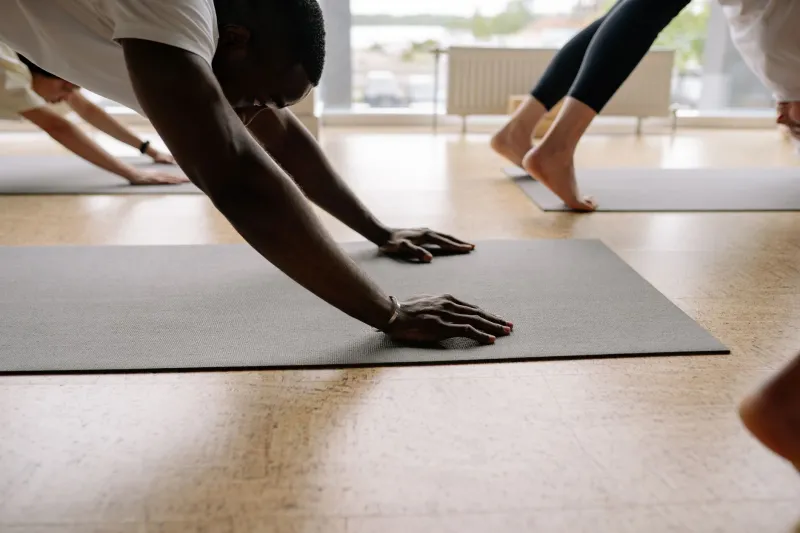
Try this before a day of meetings, or in the five minutes after you've read a message you don't want to reply to yet. Sit on a chair with your feet on the floor, or cross-legged on a cushion. Nothing fancy required.
Step one: settle and breathe. Rest one hand on your chest and one on your upper belly, just below the ribs. Breathe in through your nose to a count of four, then out through your nose to a count of six. Let the lower hand move first, if it will. Do this for eight or ten rounds — roughly two minutes. You're not trying to relax on command; you're just giving the nervous system something repetitive to hold on to.
Step two: the soft twist. Bring your hands to your thighs. Breathing in, lengthen up through the spine. Breathing out, turn gently to the right, keeping it small — maybe a quarter of the way round. Stay for three breaths, letting the exhale do the work rather than the arms. Come back through the centre, then turn to the left for three breaths.
A twist like this massages the middle rather than bracing it. Notice whether you're gripping your jaw or holding your breath to get further round. You're not trying to get anywhere. Think of the twist as a question rather than a demand.
Finish by sitting still for a few breaths with your hands back on your belly and asking, plainly: what's my answer? Then just notice what arrives — a yes, a no, or a not-yet. All three are valid.
What to say when the answer is no
We're often fluent in reasons and hopeless at sentences. So keep it short and skip the justification; lengthy explanations invite negotiation.
- "Thanks for thinking of me — I'm going to say no to this one."
- "I can't take that on at the moment, but I hope it goes well."
- "I've had a look and I don't have the capacity for it this month."
Notice there's no apology-and-excuse sandwich. "I can't" is a complete sentence and doesn't require a medical certificate.
What to say when the answer is not yet
Not-yet is the most underused answer in British working life. It buys you the pause without slamming a door.
- "Can I come back to you tomorrow morning? I don't want to say yes and then let you down."
- "Let me check what's already in the week and reply by Thursday."
- "I could do the first part of that, but not the second — is that useful?"
That last one is worth keeping. Half a yes, honestly offered, is kinder than a full yes that quietly curdles into resentment by the following Wednesday.
Family requests are their own weather
With relatives, the guilt spiral tends to arrive before the sentence does. It helps to separate the invitation from the obligation. An invitation can be declined.
- "We're not going to make it this time — could we do the weekend after instead?"
- "I'd love to see you. I'm not up for the big lunch, though, so I might come for the afternoon."
- "I'm keeping December fairly clear this year, so I'm saying no to most things — it's not about you."
That last line is doing a lot of quiet work. It names the pattern so nobody has to guess.
And if you've already said yes
You will sometimes say yes and regret it about four seconds later. That's not a failure of practice; it's just being a person with a diary. You're allowed to come back and revise: "I said yes too quickly yesterday — I've realised I can't do it properly, and I'd rather tell you now."
This isn't a project
There's a temptation to turn boundaries into another thing to be excellent at, with a scoring system and a reading list. Please don't. The solar plexus practice is just a way of giving your middle a vote. Some weeks you'll listen to it, some weeks you'll override it entirely and eat the buffet of obligations anyway.
What tends to change, slowly, is the gap. The two seconds become ten, then fifteen. And in that gap there's usually a breath, a small turn, and a slightly kinder answer than the one you'd have given on autopilot.