Softly, Then Strongly: A Quiet Yoga Sequence for Thin-Walled Flats

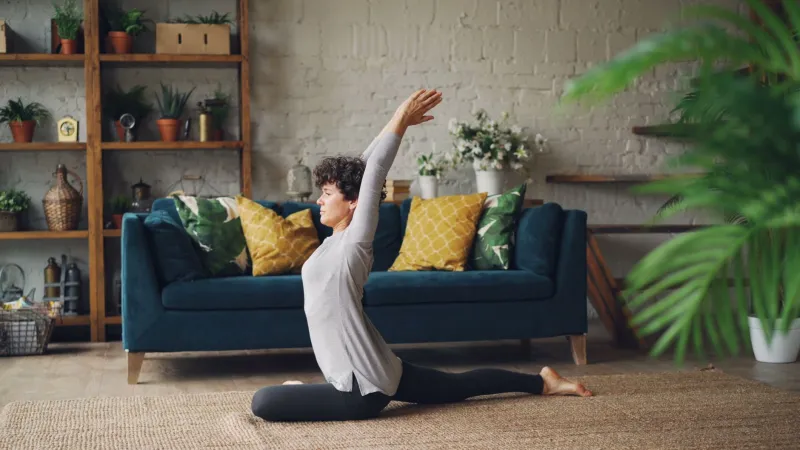
Photo: woman practising gentle yoga on a blanket in a small flat living room, natural light, calm, UK home, via www.the-sun.com
There is a particular kind of self-consciousness that comes with unrolling a mat in a rented flat. You can hear next door’s television through the wall. The floorboards announce every shift of weight. Maybe your flatmate is asleep in the next room, or the downstairs neighbour has already had a long week. You want to move, breathe and feel more like yourself — but you also don’t want to be the person thumping about at 9pm.
The good news is that quiet yoga is not a watered-down version of the real thing. It can be steady, strengthening and deeply grounding. When you take away the jumps, the rushing and the performance, you often meet the practice more clearly. This sequence is designed for small rooms, thin walls and real British flats — the kind with Victorian conversions, creaky stairs and a boiler that makes its opinions known.
Quiet does not mean passive
A slow practice asks more of you, not less. Moving gently between shapes develops control. Holding a lunge without wobbling teaches you where your weight actually is. Breathing slowly when you would rather rush gives your nervous system a different message.
In Manipura-style yoga, the solar plexus is often associated with confidence and inner warmth. That warmth doesn’t need to be loud. A quiet practice can still stoke it — perhaps more honestly, because you are not relying on momentum or music to carry you through. You are simply present with your own body in a small room, doing what you can.
Set the room before you set the intention
You don’t need a dedicated studio. A patch of carpet, a folded blanket and a wall are enough. If you have a mat, unroll it. If you don’t, a thick blanket works beautifully and muffles sound at the same time.
A few small preparations help: close the door, silence your phone, and keep a glass of water nearby. You might tell the people you live with that you’re taking fifteen minutes — not as an apology, but as a simple fact. Dim the main light if it helps you feel less on display. Candles are lovely but entirely optional; the point is to make the space feel private enough to breathe in.
A fifteen-minute shared-flat sequence
Move slowly enough that you could stop at any moment without losing your balance. Think of your transitions as the practice, not just the poses.
1. Standing arrival — two minutes
Stand with your feet hip-width apart. Let your arms rest by your sides. Feel the floor under your feet without pressing down hard. Take three slow breaths, letting the exhale be slightly longer than the inhale. Gently shift your weight from one foot to the other, then back to centre. Roll your shoulders once, slowly. No jumping, no shaking out — just arriving.
2. Seated spinal rolls — three minutes
Come onto a blanket with your hands under your shoulders and knees under your hips. Move between a gentle rounded back and a softly lifted chest, following your breath. Keep the movement small and quiet. If your wrists complain, sit cross-legged on a folded blanket and place your hands on your thighs, then roll your spine slowly forward and back.
3. Blanket-supported low lunge — three minutes each side
From all fours, step one foot forward between your hands. Slide a folded blanket under the back knee. Keep your hands on the floor or on two sturdy books. Stay low and steady rather than sinking deeply. Breathe into the back of your ribs. To come out, move back to all fours slowly and switch sides.
4. Quiet bridge — three minutes
Lie on your back with knees bent and feet hip-width apart. Press gently through your feet and lift your hips a few centimetres — no more than feels comfortable. Hold for two breaths, then lower with control. Repeat four or five times. This is a strong shape without any noise. If your lower back prefers it, simply rest with knees bent and feet on the floor.
5. Reclined twist — two minutes each side
Draw your knees towards your chest, then let them fall to one side. Place a pillow or folded blanket under your knees so you can relax completely. Turn your head the other way if it feels right. Let your exhale do the work. Unwind slowly before changing sides.
6. Rest — three minutes
Lie flat with a blanket over you. If your lower back likes support, place a rolled towel under your knees. Let your breath be natural. Feel the floor holding you. This is not a reward for the sequence; it is part of the sequence.
Breath as your quietest prop
When you are worried about being heard, the breath can become tight. Try this: inhale through your nose for a count of four, exhale for a count of six. Keep the breath soft — no forcing, no big sighs. If counting makes you tense, simply notice the out-breath and let it lengthen on its own. The quieter you breathe, the more you will hear the subtle cues of your body.
When you share more than walls
Shared living asks for negotiation. If you live with flatmates, you might agree on a regular fifteen-minute window when the living room is yours. If your flat is tiny, practise beside your bed or in the kitchen once the dishes are done. If noise is a genuine issue, mention it kindly to the people you live with. Most people are more understanding than our anxious brains expect.
And if you still feel self-conscious, remember this: you are allowed to take up space, even quietly. You are allowed to breathe, stretch and rest in your own home. The practice does not need to be dramatic to count. Softly does it — and softly, over time, becomes strong.