The Wheel Is Not a Grip: A Road-Safe Breath Practice for Tense Commutes
Most yoga advice arrives at the mat. This one arrives at the kerb. For many of us, the car is where the day gets carried: the school run, the commute, the supermarket trip, the motorway slog in the dark. By the time we pull up outside the house, the jaw is set, the hands are curled around an invisible wheel, and the belly has been braced for so long it feels like part of the seatbelt.
This is not a invitation to practise deep breathing in moving traffic. It is a small, road-safe way to use the moments when the car is already stopped: at red lights, in a queue, in a car park, or in that final minute before you switch off the engine. Eyes stay open. Attention stays on the road. The car stays a car. And the solar plexus — that soft centre around the lower ribs and upper belly — gets a chance to remember it is not responsible for holding everything together.
The car is a threshold, not a studio
We often talk about transitions as if they need a whole ritual: a candle, a mat, a quiet room. But the car is already a threshold. It sits between work and home, between one errand and the next, between the version of you who is polite on a video call and the version who just wants to put the kettle on. You do not need to add anything to it. You just need to stop gripping quite so hard.
At Manipura Yoga, we come back often to the solar plexus as a place of quiet strength rather than constant effort. In the driver's seat, that might mean noticing the difference between good posture and braced posture. One helps you steer. The other helps you arrive home exhausted. The practice below is a way of softening the second without losing the first.
At the lights: a three-minute version
This is for when the car is stationary and it is safe to do so. Keep your eyes open. Keep your foot on the brake if that is how you normally wait. If the light changes, the practice ends. That is not a failure; that is the point.
Minute one: let the wheel be a wheel
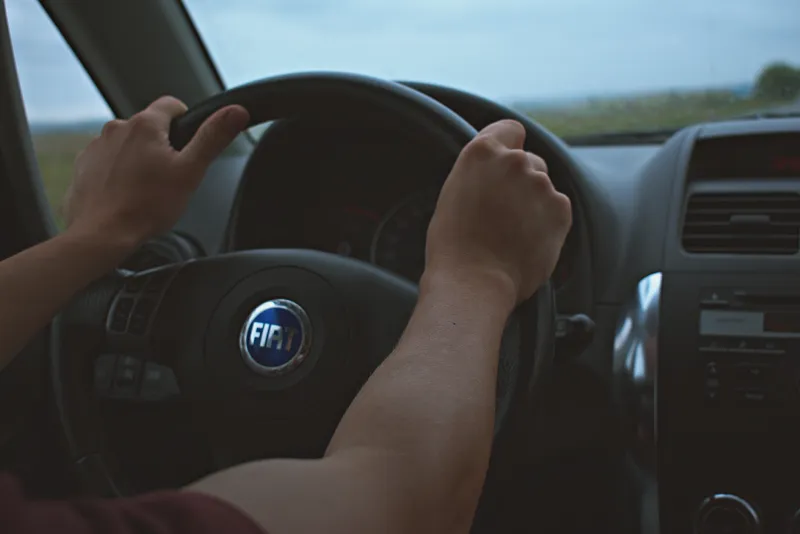
Notice your hands. Are they wrapped tightly around the wheel, thumbs hooked, fingers pale? Without moving them dramatically, let the grip soften by about ten per cent. Feel the texture of the wheel rather than trying to control it. Take one ordinary inhale through the nose, then a slightly longer exhale, as if you were fogging a window. Do that two or three times. No breath holds. No counting that takes your attention off the road. Just enough of an exhale to tell your nervous system that this red light is not an emergency.
Minute two: shoulders, jaw, hands
At the next safe stop, roll your shoulders back very slightly — a small movement, the kind a passenger would barely notice. Let them drop. Then unclench your jaw. You might find your tongue is pressed against the roof of your mouth; let it rest. Open and close your fingers around the wheel once, gently, like you are releasing a small object. The solar plexus often tightens when the shoulders and jaw do, so this is not a separate practice. It is all one soft unclenching.
Minute three: soft belly, steady gaze
Bring your attention to the band around your lower ribs. Are you holding your belly in? Many of us do it without noticing, especially when we are trying to feel in control. Let the belly be soft enough to move with the breath. You are not slumping; you are simply not bracing. Keep your gaze soft and forward. If you are waiting at a junction, let the breath be ordinary. The practice is not the big breath. The practice is the small release.
When you are parked: the fuller reset
If you have a minute or two in a car park, a lay-by, or outside the house, you can take the same sequence a little further. Put the parking brake on. Switch off the engine if it is safe to do so. Keep your eyes open if you are in a public space — this is not a meditation retreat, and there is no prize for looking serene while someone waits for your space.
Start with the hands again. Rest them in your lap. Feel the absence of the wheel. Then let your shoulders drop on an exhale, as if you were taking off a coat. Notice the solar plexus. Place one hand there if you like, or simply bring your attention to it. Ask yourself: can this area be five per cent softer? Not floppy. Not collapsed. Just less defended.
Then take three easy breaths. In through the nose, out through the nose or mouth. Let the exhale be the part you enjoy. On the last one, look around the car. Notice one ordinary thing: the dashboard, the rain on the windscreen, the sound of the indicator ticking. This is you arriving before you arrive.
What to skip in the driver's seat
There are some things that belong on a mat, not at a roundabout. Skip long breath retention. Skip anything that asks you to close your eyes. Skip dramatic shoulder rolls or neck stretches that take your attention away from the road. Skip anything that makes you feel light-headed or dizzy. If you feel unwell, stop and focus on the road or pull over safely.
The driver's seat is not the place for a full yoga practice. It is the place for a small interruption in the grip. That is enough. A softer hand on the wheel, a dropped shoulder, an unclenched jaw, a belly that is allowed to be a belly — these are not tiny things. They are the difference between arriving home as a clenched fist and arriving home as a person who might actually sit down.
Arriving home with a little less armour
When you pull up outside your house, try not to launch straight from the car into the next thing. Take one breath before you open the door. Feel your feet on the footwell. Let the solar plexus soften one more time. Then gather your things and go inside.
If you keep a journal, you might write one line later: 'I noticed the grip at the lights.' That is all. You are not trying to become a different driver. You are simply practising the art of not carrying the whole road in your body.
At Manipura Yoga, we like practices that fit into real UK lives — the wet Wednesday, the dark commute, the queue on the A-road, the school pickup that runs late. This one fits in a red light. It asks for nothing except your attention, and it gives you back a little softness for the drive home.